
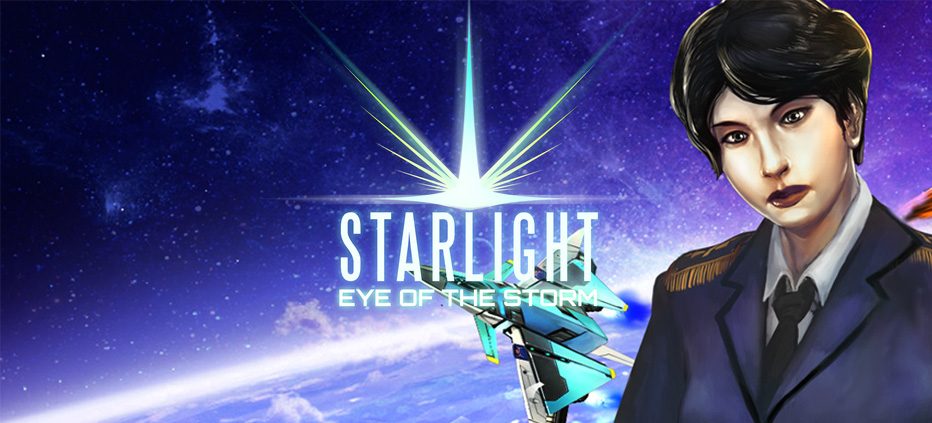
Starlight: Eye of the Storm
Developer: Strides Interactive Game Studio | Publisher: Strides Interactive Game Studio | Release Date: 2021 | Genre: Action / Bullet Hell / Indie | Website: Official Website | Purchase: Steam
Starlight: Eye of the Storm is a 2D bullet hell shooter set 300 years after the devastation of Earth by a nuclear war. As if wrecking the planet wasn’t enough, humanity also began experimenting with opening wormholes and ended up with several of them appearing near the vicinity of Earth. So when The Council of Foresight decides to use a massive wormhole to re-establish contact with the Council of Mars, you and two of your top ace pilot friends are selected for the dangerous mission. The plan is to deliver top-secret data to the local government forces orbiting Mars, but the clandestine nature of the task means your squad will be seen as targets by everyone. What this boils down to essentially is that to complete the mission, you will need to shoot down everything standing in your way while trying to avoid becoming a casualty yourself.
Bullet hell is a pretty niche genre of shooters, so it is always great to see a title that is really good and accessible enough to draw in new fans. This is undoubtedly the case with Starlight: Eye of the Storm by Strides Interactive. After spending some time in Steam Early Access, the game got a full release and burst out of the gate with some new enhancements and features. Along with the ten arcade stages, Starlight: EotS also has 15 campaign missions consisting of seven main missions and eight side missions. Players need to complete three segments per mission, but unlike the arcade mode, they can access the shop at any time. Campaign mode missions usually feature some objectives, such as preventing certain enemy ships from escaping or protecting certain allies. The campaign mode is also where the story is fleshed out via short cut-scenes. To be honest, it was a little difficult to follow what was going on at times, but then again, the genre is not exactly known for amazing storytelling.
Where Starlight does excel, though, is in the pure action-packed gameplay. The game features a selection of ships right off the bat, along with a few that can be unlocked by meeting specific criteria. Even better, the game features a ship editor that allows players to import their own JPG, PNG, or TIFF files and then them into playable ships. The editor is straightforward to use and a lot of fun, but the Steam Workshop support means that even players without artistic talent can get their hands on new ships.


Anyone familiar with the genre should know what to expect from Starlight. Enemies blast onto the screen from all directions and usually waste no time littering their surroundings with bullets. Players must retaliate while trying to weave through the dense bullet curtains. Destroying enemies rewards players with pick-ups, which can be used at the shop to buy new weapons or upgrade things like their ship’s speed, shields, and armor. Special upgrade capsules can also be earned to improve the potency of weapons. Since the game features a wide range of weapons that can be attached to different parts of the ship, there are plenty of combinations to try out. However, when the opposing fire becomes too overwhelming, players can also use their special powers and bombs to turn the tide. Depending on your ship, your special power might absorb enemy projectiles before unleashing a devastating shockwave, fire lava rocks, or start shooting the projectiles used by the strongest enemy currently on the screen. As expected, these are in limited supply but can save your hide if used at the right time. One of our favorite features in the game is the drift mode, an energy-limited ability that can be activated to pivot your ship towards enemies automatically. Upgrading the targeting computer helps it to prioritize targets, and upgrades can also extend the duration. Drifting around dodging bullets while shooting targets from behind is an absolute blast is going to make games where players can only shoot directly ahead feel a bit limited for us from now on.
Although Starlight can look daunting in screenshots, it has multiple difficulty options to choose from as well as settings such as the number of lives and credits that players can adjust. There’s also a tutorial to help newcomers, but cranking up the difficulty should give veterans plenty to sweat about too. It’s even possible to exit the game and continue the arcade or campaign mode from the stage where you left off when you come back, which is something we would like to see in more shooters. The game can be played with up to three players simultaneously, which is chaotic, to say the least. In addition to the Arcade and Campaign modes, players can also take on each other via the Duel PVP Mode. Since Starlight is Steam Remote Play compatible, you don’t even have to be in the same room as your friends to team up with them or blast them out of the sky.
Visually, Starlight can hold its own with some of the best in the genre, and each screen is packed with enemies and bullets. For the most part, the backgrounds are kept relatively simple, which makes it easier to concentrate on all the bullets constantly heading your way. However, while the game is 2D, the backgrounds are 3D, giving some areas a nice bit of depth. It also means that some things like asteroids can move from the background to the foreground and cause damage if you are not careful. During Early Access, the game was restricted to a 4:3 screen mode, but 16:9 was added for the full release. This means that the game looks great in higher resolutions and nothing is stretched or distorted when played on widescreen monitors. It has several visual options that players can adjust to increase performance or make the game look better, depending on the power of their PC. The developers also gated the game at 40fps, so instead of dropping frames, the game will slow down if your PC struggles to keep up with the action. Our experience with the game was very smooth, though, even during some of the boss battles during later levels, where bullets filled almost every inch of the screen.
Instead of a frenetic soundtrack, the music in Starlight is a little more laid back, which is a good thing. The sound effects are as over the top as one would expect from a bullet hell shooter, though, especially as there is rarely a reason ever to take your finger off the firing button. Unfortunately, there’s no voice acting for the dialog during the cut-scenes, but it is understandable as this is not a big-budget release. We completed both the arcade and campaign modes of the game using an Xbox One controller, but Starlight is also perfectly playable with a keyboard.
If you are a fan of the bullet-hell shooter genre, then Starlight: Eye of the Storm is a must. However, even if you are generally intimidated by the genre, we still recommend trying out the game as it is very newcomer-friendly. Replay value is not an issue either, as there’s plenty of achievements to earn, and we had a blast trying out the many different weapon combinations. Add a few friends, and you have a game that will keep you coming back for more.
System Requirements
- OS: Windows 7
- Processor: i3-5XXX CPU or higher with support for SSE3 instructions
- Memory: 4096 MB RAM
- Graphics: ATI R7 250 or GeForce GTI 940MX or similar card that supports shader v3.0 with at least 1GB of VRAM
- DirectX: Version 9.0c
- Storage: 3200 MB available space
- Sound Card: DirectX Compatible Sound Card
- Additional Notes: Windows NT / Server editions not supported. Win7 has EOL-ed since 14/01/21 and may not be fully supported in the future.
- OS: Windows 10
- Processor: I5-6500 or higher with support for SSE instructions.
- Memory: 8192 MB RAM
- Graphics: ATI Radeon RX 580 or GeForce GTX 1650 and above that supports shader v3.0 with at least 2GB of dedicated VRAM
- DirectX: Version 9.0c
- Storage: 4000 MB available space
- Sound Card: DirectX Compatible Sound Card
- Additional Notes: Windows NT / Server editions not supported.


