

Nex Machina
Developer: Housemarque | Publisher: Housemarque | Release Date: 2017 | Genre: Action / Twin Stick Shooter / Indie | Website: Official Website | Purchase: Steam
The first few moments in Nex Machina, especially when disregarding the suggestion to play on “rookie” difficulty, are typically spent frantically running around trying to avoid getting shot. The game is set in the future, where machines reach consciousness and promptly begin eradicating human life. Players must leap into action and destroy these robots while saving the humans milling about. However, the human saving part appears to be optional as each level ends as soon as the last robot is destroyed, regardless of how many humans were saved.
Nex Machina is an intense arcade-style twin-stick shooter which was clearly influenced by the likes of Robotron and Smash TV. In fact, Eugene Jarvis, known for his work on the aforementioned games as well as Defender, Robotron: 2084, and more, served as a creative consultant for Nex Machina. While this doesn’t make it clear exactly how much input he had, the spirit of those classic shooters can be felt in every aspect of Nex Machina. It is a game of pure action and, as mentioned earlier, lots of frantic running around trying not to get shot. However, players will eventually reach a point where the tables are turned, and they become the hunter instead of the hunted. The patterns in those seemingly endless barrages of bullets and enemies become a little clearer. It becomes easier to chain kills together while building up a combo for rescuing humans. Where initially, players might have been in a frenzied rush to save all humans as quickly as possible, the merits of spacing these out for bigger scores soon becomes obvious. It is at this point where the real fun begins, and each level becomes a carefully orchestrated dance of dashing, destruction, and last-second rescues.
With only six worlds on offer, it doesn’t take very long to blast through Nex Machina. Each world has about fifteen stages, culminating in a boss fight at the end, but most can be blasted through in a matter of seconds. After completing Arcade mode on the default difficulty setting, players can opt for harder playthroughs, which makes enemies more aggressive while also putting stricter limits on things like lives and continues. However, even on the easiest setting taking one hit means death unless players are equipped with a shield power-up. Death is something to avoid at all costs, as it not only restarts the current level but also decreases the score multiplier and causes players to drop their power-ups. Speaking of power-ups, these include things like an explosive dash, spread fire, triple dash, and the aforementioned shield. These can make survival a lot easier, especially when combined with secondary weapons ranging from detonators to rocket launchers, lasers, and even swords. Players can only carry one at a time, so care must be taken not to pick up something in the heat of battle accidentally.
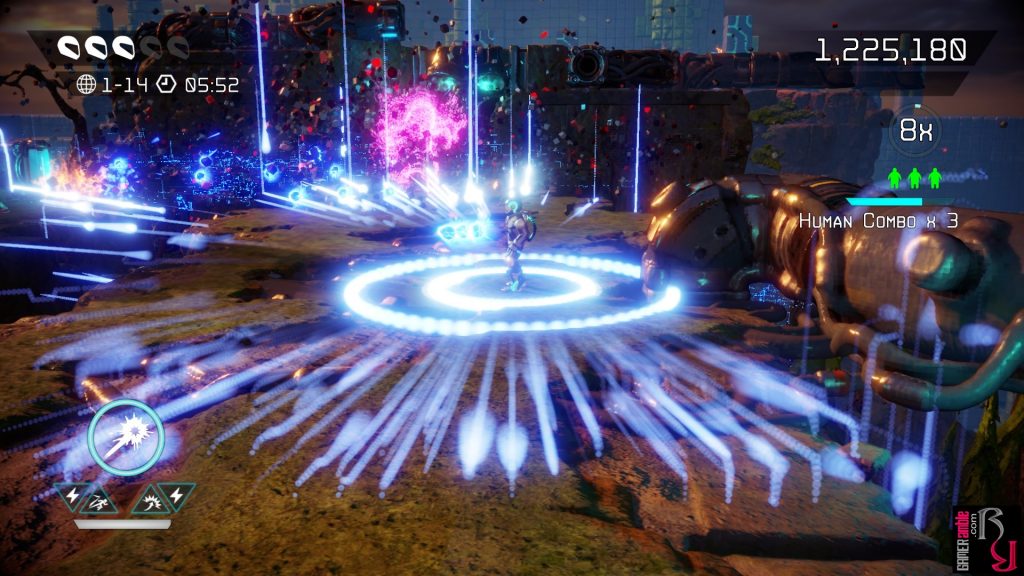
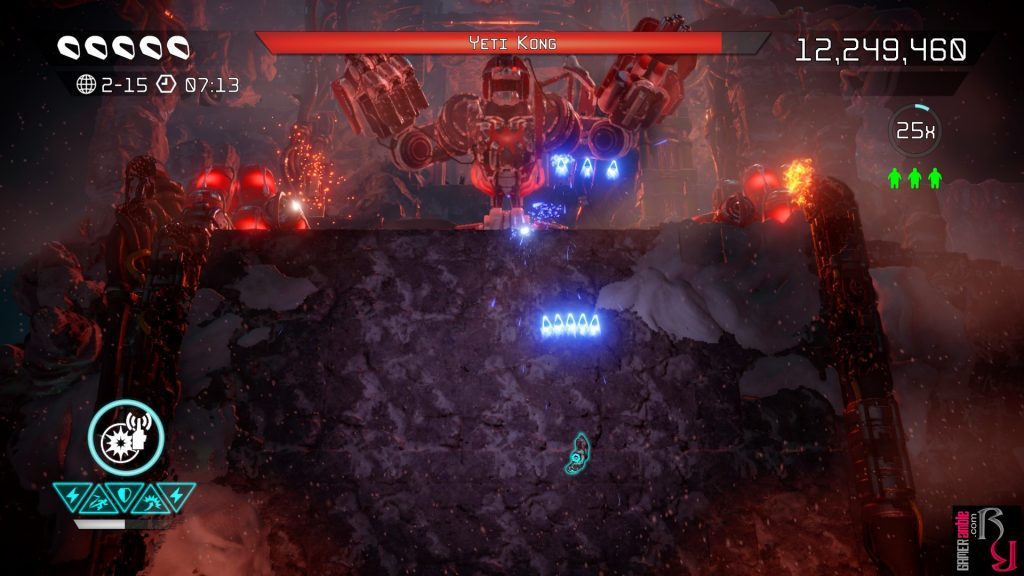
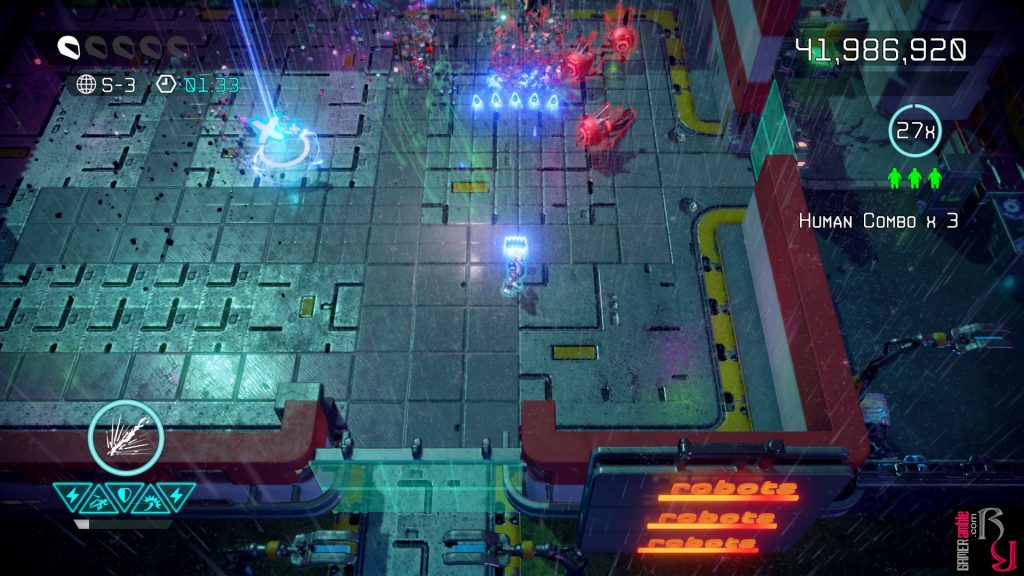
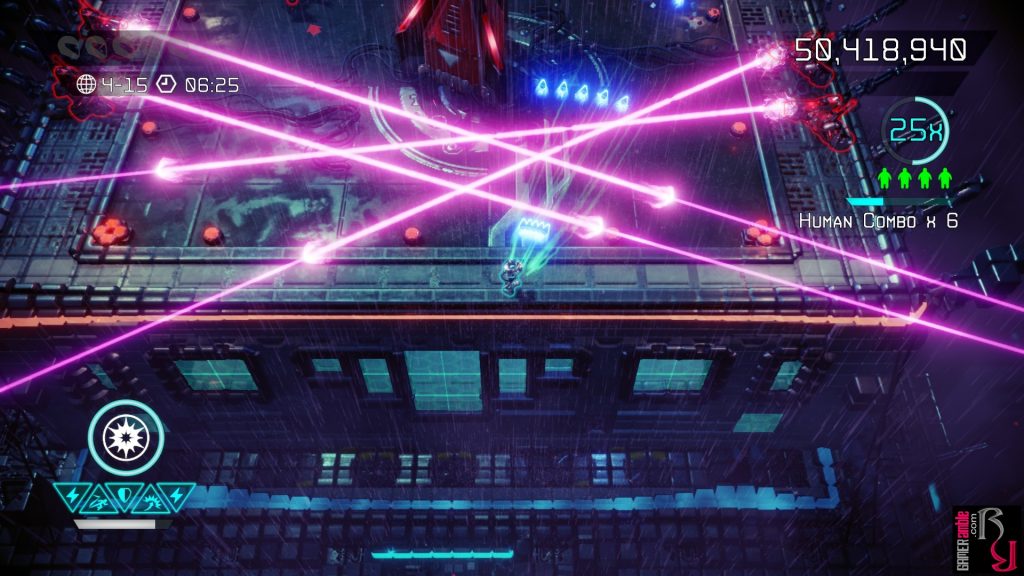
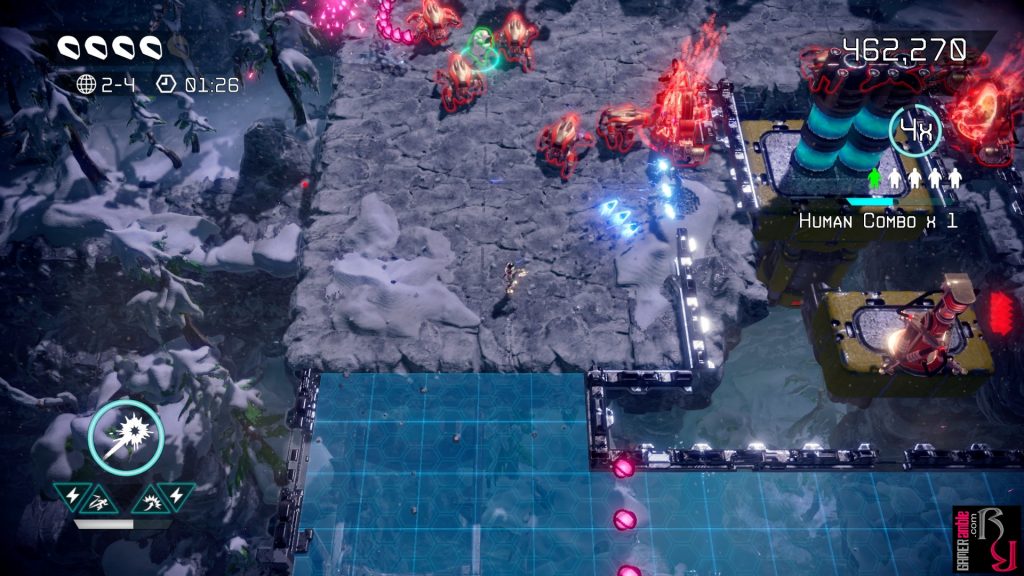

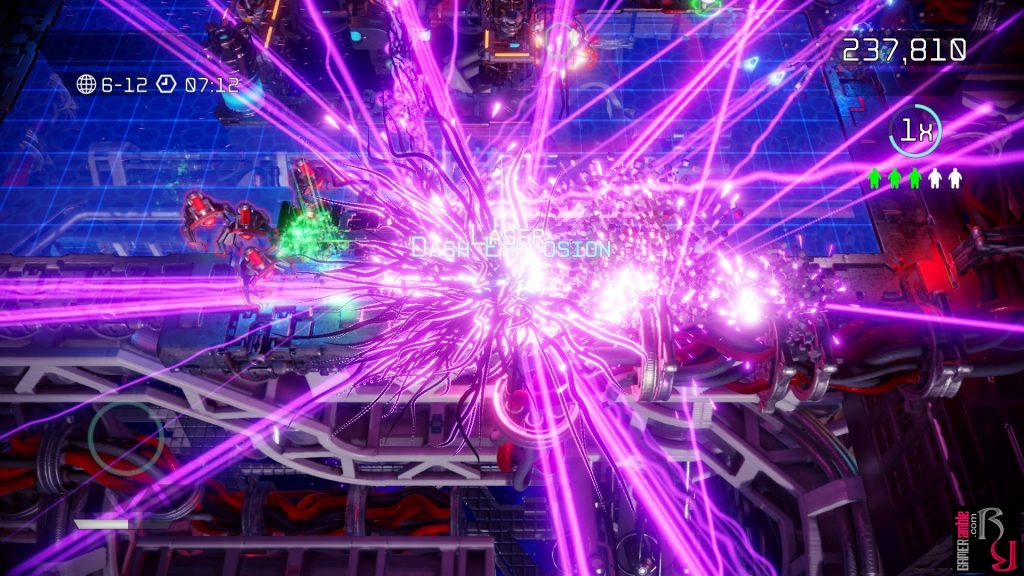
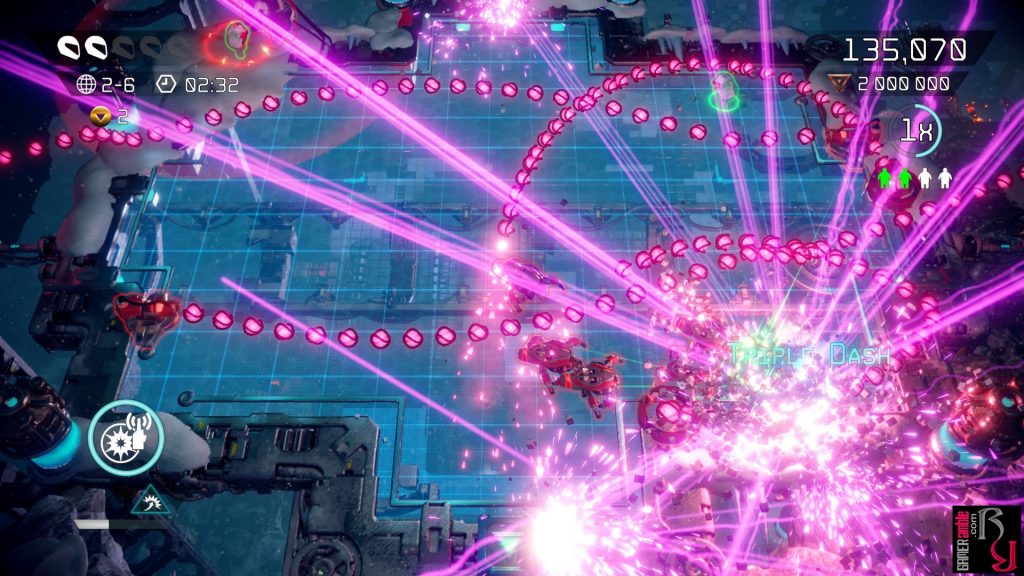
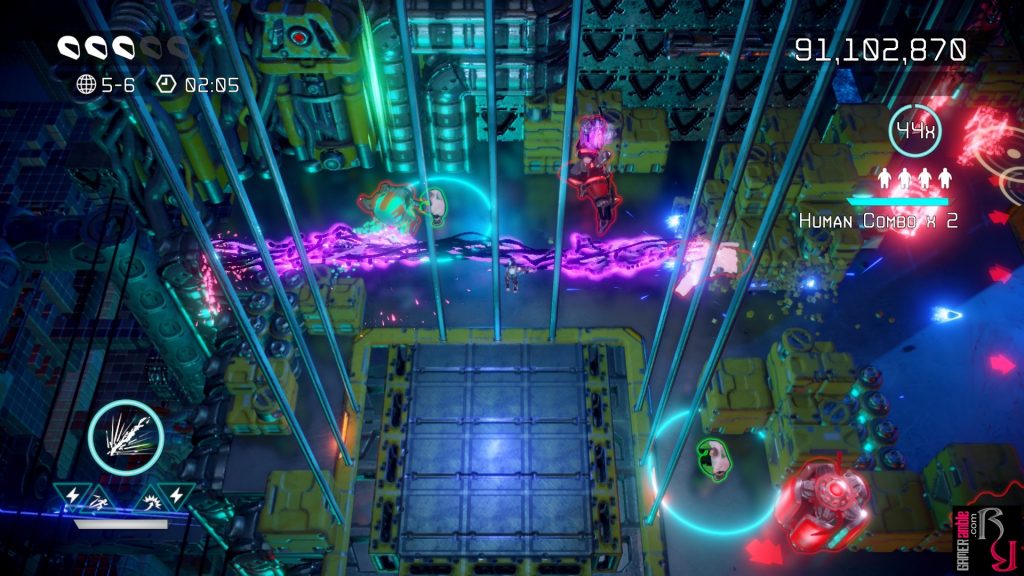
There’s a lot of fun to be had in Arcade mode, but Nex Machina also allows players to select a single world for practice purposes. This is a great way to earn some of the achievements for specific levels without having to play through all the levels in sequence each time. However, most of the replay value comes in the form of the Online Arena. This mode challenges players to complete worlds under specific conditions. These can range from putting on the highest score under a strict time limit to facing enemies that are much faster than usual. This mode features limited lives, and no continues, but bronze, silver, and gold medals are dangled in front of players to keep them coming back for more. Along with the community and friend leaderboards, which even allow players to watch how others played the game, makes Nex Machina a very replayable game. In addition, it supports local co-op, so players can team up to take on the robot menace.
With the fast pace, small levels, and relentless enemies, Nex Machina definitely feels like a classic arcade shooter. The game is all about action and high scores, so each run relies on pure skill and a little luck, as there are no rogue-like elements or perks that carry over. Since the arenas are not very big, dodging is essential, and mastering the dash move to weave between enemies and bullets is a must. However, somewhat annoyingly, later levels introduce certain projectiles that cannot be dashed through, which does interrupt the flow of things a bit. Nevertheless, the game is a lot of fun and perfectly captures the “one more go” feel that has been a staple of everything Eugene Jarvis has worked on.
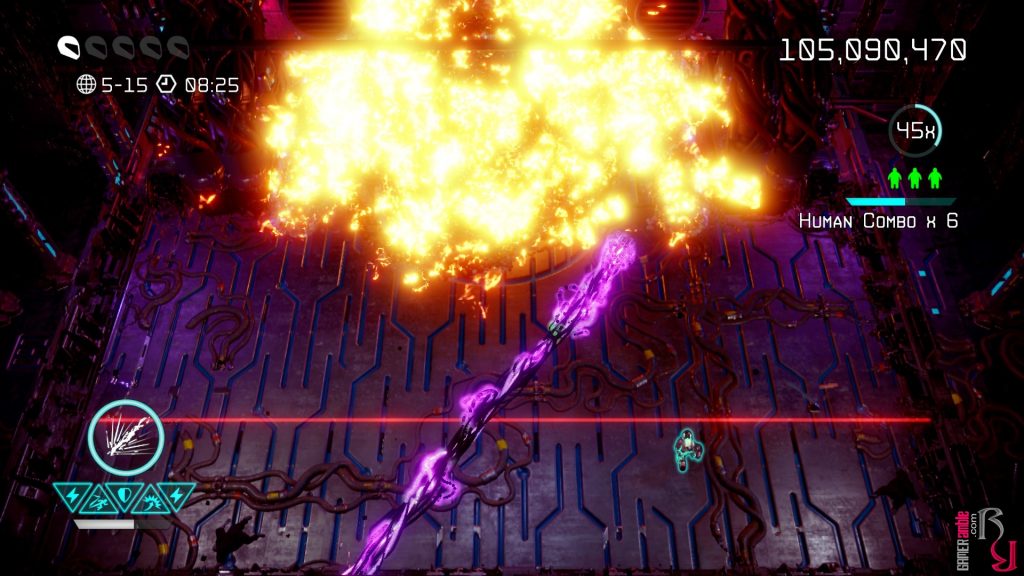
Visually, Nex Machina makes good use of voxels to build its world and enemies. This means that everything dies in satisfying explosions of debris. The game is viewed from an isometric overhead perspective and also features some impressive transitions between levels. Nex Machina is also filled to the brim with the usual assortment of neon explosions and blinding lasers, while bosses are big and mean and go through multiple phases as players whittle down their health. All the enemies consist of robots, but once again, there’s more than enough variety in their designs and patterns to keep players on their toes. Every good shooter needs an adrenaline-pumping soundtrack to accompany the action, and Nex Machina doesn’t disappoint in this regard. The music sets the tone nicely for each level and continues playing if players die and have to restart a level. This is a lot nicer than similar titles where the soundtrack also resets if players lose a life. Sound effects sound good, and the game features an announcer who informs players when humans are lost or saved and what power-ups or weapons have been acquired.
Since Nex Machina is a twin-stick shooter, it is ideally played on a controller with two analog sticks. Movement is handled with the left stick, while the right can be held in any direction to unleash a barrage of bullets. Secondary weapons are relegated to the right trigger, and the left trigger is used for dashing. Overall, the controls are responsive and pulling off moves like dashing while swinging the sword is very satisfying.
Anyone who grew up playing the games Eugene Jarvis worked on or loves a good arcade shooter should definitely add Nex Machina to their collection. While six levels might not sound like much, the game has more than enough reasons for players to keep playing. Nex Machina can quickly gobble up your free time thanks to the secret levels, secret humans, feats, achievements, and high scores. It’s not the type of game for players who want to reach the credits once and then never play again, but everyone else should strap themselves in for bullet hell heaven.
System Requirements
- Requires a 64-bit processor and operating system
- OS: 64 bit Windows 10 / 8 / 7
- Processor: Intel Core i5-4690 or AMD FX-4300
- Memory: 4 GB RAM
- Graphics: 2 GB Video RAM – NVIDIA GeForce GTX 760 or AMD Radeon R9 270
- DirectX: Version 11
- Network: Broadband Internet connection
- Storage: 1 GB available space
- Requires a 64-bit processor and operating system
- OS: 64 bit Windows 10 / 8 / 7
- Processor: Intel Core i5-4690 or AMD FX-4300
- Memory: 8 GB RAM
- Graphics: 4 GB Video RAM – NVIDIA GeForce GTX 970 or AMD Radeon R9 390
- DirectX: Version 11
- Network: Broadband Internet connection
- Storage: 1 GB available space


bionoid January 1, 2023
All humans saved !
GAMERamble January 1, 2023
Not that they deserve it or anything. They can be lucky we needed the score multiplier!